

Humic Acid Effect on Citrus Trees: Unlock Growth & Yield
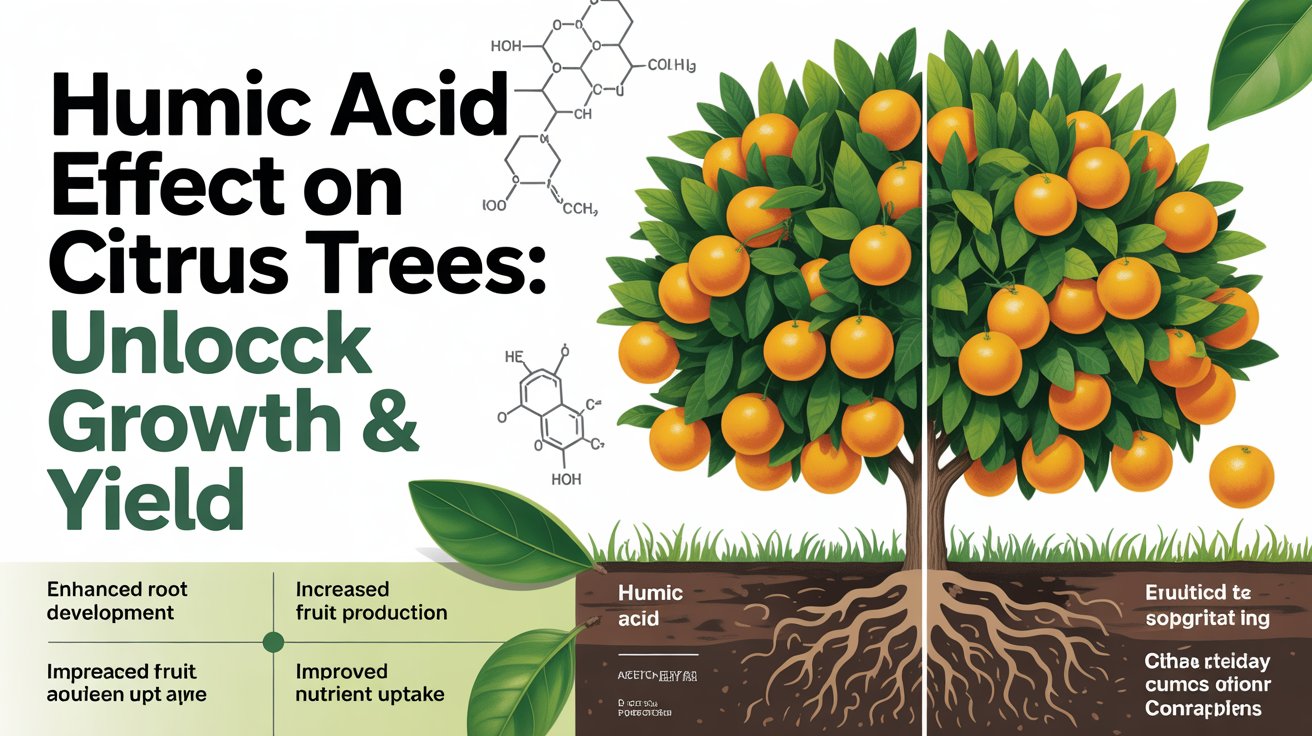
Humic acid for citrus trees is a natural stimulant that brings the soil back to life, aiding in the health of the tree from the root zone up. Humic acid comes from ancient organic material that is composed of highly carbonaceous biological compounds, which boost nutrient absorption, soil health, and plant vigor. Humic acid works like a humic acid fertilizer that enhances the availability of nutrients, such as nitrogen, phosphorus, and potassium, to ensure that citrus trees receive what they need to thrive and produce fruit.
Humic acid is a critical element in improving root development, increasing chlorophyll levels, and enhancing soil moisture for citrus crops such as oranges, lemons, and limes. Energy efficient roots are strong roots that will allow the trees to more effectively uptake nutrients leading to better overall fruit yields, fruit quality, and juiciness. Humic acid also increases soil microbe activity found in the root zone to aid in decomposition of organic matter and nutrient conversion into forms available to citrus trees for uptake. This will increase fruit yields and build fertility in soils over time.
Introduction: Unlocking the Power of Humic Acid for Citrus Trees
Citrus trees perform best in nutrient-dense, well-aerated soils; this is when humic acid for citrus trees can become a true game changer. Humic acid, derived from natural organic matter, is a biological activator that increases soil fertility, enhances immigration growth, and increases overall yield. Humic acid is not a typical fertilizer; it enhances the citrus tree's ability to utilize available nutrients. Over time, when humic acid fertilizer is sustainably applied to citrus trees, it helps citrus plants more effectively access more nitrogen, phosphorus, and potassium, while experiencing more steady growth, and quality fruit.
Whether you grow oranges, lemons, limes, or mandarins, using humic acid consistently will help your trees become healthier, develop stronger roots, gain greener leaves, and yield more sweeter and juicier fruit. Plus, it is an environmentally-friendly practice that should help sustainably feed you cacti.
What is Humic Acid and Why Citrus Trees Need It
Humic acid is a naturally-occurring substance that comes from the organic breakdown of materials like leonardite, peat or compost. Humic acid is rich in carbon, hydrogen, oxygen, and several functional groups which react with soil minerals and plant roots. In short, humic acid serves as a mediator between soil and plant—promoting nutrient transfer, soil texture, and microbial activity.
Citrus trees are heavy feeders or use up more nutrient resources than usual, and they generally do not perform well in soil that is poor or degraded. Humic acid for citrus trees assists in restoring soil vitality, which allows citrus roots to access nutrients that have otherwise been locked up in the soil. Humic acid exchange micronutrients (e.g., iron, zinc, and magnesium), all of which are important for chlorophyll production, flower development and fruit set.
Regardless, you will want to consider various functions of humic acid for citrus trees:
1. Stimulate root growth for improved uptake of nutrients
2. Increased aeration and water holding capacity
3. Stimulate beneficial soil microbes
4. Improve efficiency of fertilizers — reduced losses
5. Promotes stronger, healthier and more vibrant trees for future harvests
Benefits of Humic Acid Fertilizer for Citrus Growth
1. Enhanced Root Development:
Humic Acid promotes the production of new root hairs and elongation for better water and mineral absorption by the citrus plant.
2. Enhanced Nutrient Uptake
Humic Acid acts as a natural chelator, binding with nutrients and maintaining plant access to them.
3. Enhanced Fruit Production and Quality
Repetitive usage of humic acids allows the citrus tree to produce more fruit, larger fruit size, better flavor, and improved to much better color uniformity.
4. Increased Photosynthesis and Chlorophyll
Humic acid will not only improve iron and magnesium availability but leaves have improved greenness and photosynthetic efficiency.
5. Reduced Plant Stress
Humic Acid fertilizer will allow trees to recover from environmental stressors - such as heat, drought, salinity or waterlogging - more efficiently by strengthening cell walls.
How Humic Acid Improves Soil and Plant Health
Soil Health Improvement: Humic acid increases cation exchange capacity (CEC), so that the soil can retain and supply more nutrients. It balances pH, and can neutralize toxins or heavy metals that may interfere with root growth. This creates a happy ecosystem for earthworms and microbes to continue enriching the soil.
Plant Health Improvement: The improved presence of nutrients made available by humic acid for citrus trees has enhanced nutrient absorption of macro and micronutrients, such as nitrogen, phosphorus, potassium, calcium, and magnesium, from the soil by the roots. These nutrients are essential for physiological processes such as chlorophyll synthesis, enzyme activation, and cell division, which all promote a healthier, more vigorous plant.

The Science Behind Humic Acid and Its Role in Citrus Tree Growth
Humic acid for citrus trees goes beyond a soil conditioner; it is a natural biostimulant that changes the way plants uptake nutrients and grow. Humic acid fertilizer comes from the decomposition of organic matter, such as leonhardite or peat, and has an active role in the soil. Humic acid helps rebuild the soil and structure, promotes microbes, and enhances the entire ecosystem around the citrus roots.
Citrus crops such as oranges, lemons, and limes strongly benefit from humic acid as it enhances root development, increases chlorophyll production, and aids nutrient transfer within the tree. As a result, trees are stronger while leaves are greener and fruit juicier, with a more superior quality from harvest to market.
Humic Acid Effect on Plant Growth and Nutrient Absorption
Enhances Nutrient Uptake Efficiency:
- Transforms locked nutrients (example: phosphorus & iron) to soluble forms that are readily taken up by roots.
- Promotes soil pH balance, enhancing nutrient mobility in acidic and alkaline soils.
- Lessens the excessive application of chemical fertilizers, decreasing costs while protecting soil health and sustainability.
Promotes Better Leaf Health and Growth:
- Encourages the production of chlorophyll which promotes deep green foliage and generates elevated rates of photosynthesis which gives you colorful, healthy foliage.
- Provides a constant rate of growth when the plants are actively under stress such as heat and drought by helping to improve the soil's ability to hold moisture and optimizing plant defenses.
- Leads to efficient formation of fruit and consistent sizing by balancing nutrient uptake and improving plant hormonal activity.

Enhancing Root Development with Humic Acid for Citrus Trees
1. Encourages Root Growth and Density:
Humic acid encourages root cell division and elongation, allowing citrus roots to access less nutrient-dense depths of soil and water. This is helpful in sandy or saline soils with low moisture retention.
2. Enhances Root Respiration and Nutrient Exchange:
By loosening compacted soils, humic acid for citrus trees eases oxygen exchange and nutrient contact at the root surface.
3. Aids in Transplant Recovery and Initial Growth:
When used in the early season or transplanting, humic acid can aid citrus seedlings with root shock which aids establishment and early growth vigor.

Stimulating Soil Microbes and Improving Fertility
When soil is healthy, citrus trees are healthy and humic acid fertilizer is the link that brings soil life back to life! It acts as food for the beneficial microbes that promote biological activity that improves decomposition, nutrient recycling, and natural disease suppression.
Microbial & Soil Fertility Benefits:
- Increases microbial population: Stimulates the growth of nitrogen-fixing and phosphate-solubilizing bacteria.
- Improves organic carbon: Improve soil structure and long-term fertility.
- Lowers reliance on chemistry: Reduces the use of synthetic fertilizers.
- Improves soil immunity: Increases resistance to harmful organisms.

Key Benefits of Using Humic Acid for Citrus Trees
Humic acid applications for citrus trees are an all-natural way to increase soil fertility and tree performance. Humic acid functions as an organic biostimulant that works to reestablish the soil ecosystem while increasing nutrient availability and promoting stronger, healthy trees. Humic acid fertilizers bind the essential minerals that citrus trees need to optimize growth, flowering, and fruit production while improving overall soil structure to ensure that citrus trees have an available and constant supply of nutrients and moisture.
When applied in citrus orchards, humic acid also creates a "bridge" between soil. This process helps plants absorb nutrients more effectively and increases initial root and tissue development hypervolume. Over extended periods, deep, fibrous root systems are promoted by humic acid, increasing water retention and drought tolerance, an important distinction in hot, dry climates, where citrus trees typically struggle.
Increased Fruit Yield and Quality
When citrus trees are given a sufficient amount of nutrition by using a humic acid fertilizer, their productivity and quality of fruit will increase substantially. Humic acid improves the cation exchange capacity (CEC) of the soil – therefore, this helps the soil hold more nutrients in plant-available forms. This allows for a consistent supply of nutrients during the growth cycle, and promotes a higher quality, larger, juicier and tastier fruit.
Benefits:
- Better uptake of nutrients, especially nitrogen and potassium.
- Increased fruit size, sweetness, and uniformity of color.
- Reduction in fruit drop early on.
- Increased peel strength for a greater shelf life after harvest.

Improved Stress Resistance and Tree Vitality
Citrus trees can suffer from stress due to drought, salinity, and extreme temperature. Humic acid is a natural stress reliever that can improve your soil health and give strong roots to your trees. It helps improve the plant’s capabilities to tolerate drought and nutrient deficiency by allowing important minerals to stay available for a longer period of time.
Over time, regular applications of humic acid to the soil not only improves soil conditions, it also wakes up beneficial microbes to assist the trees in building a balanced ecosystem. With a healthy ecosystem, the citrus plants will remain healthy and resilient. Farmers notice stronger branches of the tree, less leaf drop, and a more consistent flowering.
- Boosts root structures for water absorption during dry periods.
- Allows for balanced nutrient uptake and prevents excess salts build up from nutrients introduced.
- Boosts chlorophyll production, resulting in green and healthy leaves.
- Reduces oxidative stress to help trees recover more quickly from pruning or attacks of disease.
Eco-Friendly Solution for Sustainable Farming
Sustainability is at the heart of virtually all modern agriculture, and humic acid is a natural option within sustainable lifestyles. Humic acid is available from natural sources, like leonhardite or composted organic matter, and can improve soil quality without adding harmful inputs to the environment. Humic acid also maximizes action from chemicals already present in the soil, lowering or eliminating the need for fertilizers.
Specific benefits include:
- 100% biodegradable and safe in soils and water.
- Increases organic carbon levels in soil for longer-term fertility.
- Reduces leaching of fertilizers into surface water and groundwater.
- Enables sustainable citrus farming at lower costs.

Application Methods for Humic Acid Fertilizer
Humic acid can be used for citrus trees in a variety of ways depending on soil type, age of the tree, and stage of growth. The preferred methods are applied as a soil drench, foliar spray, and through drip irrigation; each one fills a particular need of the citrus plant. The important part is consistency and dilution to prevent overuse while still getting the advantage of the product working efficiently.
Humic acid is applied directly in the root zone of the tree before the growing season begins. The substance should be mixed in the top 10–15 cm of the soil, or you may apply with irrigation water. The application should both enhance microbial activity and create a nutrient rich zone where the roots can grow.
For larger orchard use, humic acid can be added into the drip system of the irrigation. This will ensure proper and evenly distribution for consistent feeding for every tree while enhancing nutrient uptake in addition to water use efficiency.Many farmers will also combine soil and foliar applications for both benefits of soil fertility and improving leaf uptake.
Soil Drench and Foliar Spray Techniques
When applied correctly, Humic acid strengthens root growth and enhances the citrus tree’s ability to absorb nutrients and water. Here’s how you can use humic acid effectively:
Soil Drench:
- Combine 5–10 ml of humic acid liquid for every liter of water.
- After mixing, apply around the root zone of your trees in the early morning or evening.
- You can even repeat applications every 15–20 days while your trees are actively growing or fruiting.
- This procedure is safe for young and mature citrus trees.
- This practice improves soil structure, promotes root development, and improves microbial activity in order to hold nutrients longer in the root zone.
Foliar Spray:
- Make a diluted solution with 3–5 ml/L of humic acid.
- Once mixed, apply to the foliage by spraying, making sure to spray on the underside of the leaves, as well.
- Try not to spray on a hot day where evaporation is a possibility; the cooler hours of the morning or evening are ideal.
- You can repeat this every 2-3 weeks during the growing season.
- The foliar spray allows the plant to absorb humic substances directly through the leaves and access to these substances should result in increased chlorophyll content.
Recommended Dosage for Citrus Trees
The amount of humic acid fertilizer applied to citrus trees is critical because it indicates the efficiency in which trees can absorb and utilize nutrients without causing unbalance or loss. Citrus crops are sensitive to nutrient deficiency or excess; a correct application rate of humic acid would ensure soil–plant balance. When applied at the correct application rate, humic acid aids in the improvement of soil structure, facilitates root development, and increases the bioavailability of key elements such as nitrogen, phosphorus, and potassium providing easy, stable growth for the trees.
Application of humic acid at a rate greater than what is needed may create excessive organic build-up, create pH swings, or nutrient lockout; on the contrary, application at a rate less than optimal may not achieve the desired benefits of humic acid fertilizer, e.g., nutrient uptake or stress toleration.
Here’s a recommendation of effective dosage:

Timing Applications for Maximum Effect
The timing of humic acid for citrus trees is important for achieving maximum yield and high-quality fruit. Applying at the appropriate growth stages for leafy growth, root development and fruiting and fruit maturation will help achieve strong roots, rich foliage and flavorful juicy fruits.
1. Pre-Growth Season (Early Spring)
Horticulturists can use soil drench application of humic acid fertilizer before new shoot growth.
This will help to incite root activity and enhance early nutrient uptake.
2. Flowering Stage
The use of humic acid via foliar spray can promote flowering and help reduce flower drop.
This can help with pollen viability and fruit set.
3. Fruit Development Stage
During the fruit expansion, it is recommended to make either drip irrigation applications of humic acid or foliar spray applications every 15–20 days.This is important to help create larger and better fruit color.
4. Post-Harvest Period
Horticulturists should make a humic acid application to the roots to aid in recovering the root design and maintaining or increasing organic matter in the soil.This application is important because it allows for the preparation of the tree for the next growing cycle
Choosing the Right Humic Acid Product for Your Orchard
When selecting the best humic acid for your citrus tree production, consider your orchard's soil type, watering method or irrigation, and desired management practices. Humic acid can be used as a natural promoter of soil health and nutrient utilization. The right choice of humic acid can improve your trees' growth rates, nutrient uptake, and fruit production.
Before purchasing, always verify the source, the concentrations of humic acid, and compatibility with other materials. Higher quality humic acid fertilizers are derived from an inherently humic substance rich source of humic acid, named leonardite.
When considering humic acid products for citrus trees:
- For orchards with drip irrigation, choose a liquid humic acid to allow for uniform and rapid absorption of the humic acid materials.
- For traditional and/or rain-fed orchards, opt for granule humic acid whereby the materials will leach out more slowly and consistently due to the longer duration of rainfall
- Also, routinely check that you are not applying the humic acid or fertilizer that are high in heavy metals and that are compatible with other available fertilizers.
Liquid vs Granular Humic Acid Products
Liquid Humic Acid: Instant Nutrient Boost
- Excellent for fertigation, drip irrigation, or foliar sprays.
- Fast acting; nutrients become available right away, (available) for fast nutrient deficiency correction or stress recovery.
- Application rate is generally 3-5 ml/L in foliar sprays, or 1-2 L/acre through drip application.
Granular Humic Acid: Long-Term Soil Enricher
- Preferred for blending in soil, basal application, or mixing with compost or manure.
- Slow acting. Builds soil fertility in the long term.
- Enhances soil texture and moisture retention.
- Typical application rates are 2-3 kg/acre for soil preparation or early growth.

Evaluating Product Quality and Certifications
Not all humic acid fertilizers are the same. The quality can vary quite a bit depending on the source of the material and the extraction process used. There are three main areas to look for when assessing:
1.The Source Material:
Always choose humic acid that is extracted from either leonardite (a type of oxidized lignite) or peat; it will have much higher levels of humic and fulvic acid than low-grade lignite.
2.The Concentration and Purity:
A good liquid humic acid will have at least 10–12%, and granular forms should be packaged at 50%–70%. And remember to avoid low-grade humic and any that are high in sodium.
3.Certifications and Lab Reports:
Most reputable brands will supply a certificate of analysis, or COA, that has been lab-tested. Your product will have some kind of organic certification and will not have any harmful residues.

Cost-Effectiveness and Long-Term Value
The up-front cost of humic acid fertilizer may be relatively more expensive than regular fertilizers, but its long-term value is well worth the price. Humic acid will improve your soil fertility over time, lowering your dependency on chemical fertilizer and the frequency of irrigation.
Advantages that make humic acid fertilizer cost effective:
1.Increases fertilizer utilization by 30–40%.
2.Decreases loss of nutrients, such as those from leaching or volatilization.
3.Enhances yield and consistency of size of fruits over seasons.
4.Adds to soil organic carbon lasting for years.

Real-Life Success Stories: Farmers Using Humic Acid
Farmers throughout India and around the globe are experiencing a significant change in their citrus orchards after employing humic acid for citrus trees into their farming practices. What was once simply another soil additive is now widely regarded as an effective natural growth enhancer of soil fertility, soil health, root growth, and overall fruit quality and yield. The effects of humic acid fertilizer extend well beyond productivity at the moment; it rebuilds the long-term health of soil from the inside out, a win-win for citrus farmers.
Farmers of many citrus-producing areas (for instance, orange orchards in Nagpur, lemon fields in Andhra Pradesh, kinnow growing regions in Punjab, etc.) have faced challenges for many years around soil erosion, fruiting inconsistently and nutrient loss associated with heavy inputs of chemical fertilizers. The introduction of humic acid has changed the game.
Transforming Yields in Citrus Orchards
A. From Low Yield to Record Harvest – Farmer: Mahesh Patel (Maharashtra)
Mahesh Patel, an orange cultivator from Nagpur, was seeing limited productivity as a result of poor soil structure and weak root system development. After using humic acid fertilizer through a drip irrigation system for one treatment, a visible change occurred.
- Before the humic acid: Trees had yellowing leaves, and the size of fruit produced was not uniform.
- After 3 months: The root system continued to build out, and the color of the leaf was dark green.
- After 6 months: There was a 28% increase in yield. The fruits were uniform in shape, juicier and had a longer shelf life.
B. Lemon Orchard Revival – Farmer: Kavita Reddy (Andhra Pradesh)
Kavita Reddy was experiencing nutrient deficiency in her lemon orchard, as well as serious fruit drop. To address these problems, she started using humic acid fertilizer with organic manure.The result after one growing cycle was as follows:
- The soil was more moisture retentive.
- Trees produced more new growth.
- Fruit drop decreased by 40% and overall quantity produced increased by 22%.
C. Sustainable Success – Farmer: Ramesh Yadav (Rajasthan)
In Rajasthan's sandy soils, Ramesh Yadav's kinnow orchard was experiencing lesser water retention. Adding liquid humic acid via drip irrigation led to big changes:
- Water use was reduced by 25%.
- Soil organic content increased.
- With consistent flowering and fruit set, yield overall increased by 30%.
Testimonials on Soil and Tree Health Benefits
1.Our soil has come back to life! - A citrus farmer from Andhra Pradesh
“After years of fertilizer application, our soil had turned dense and without life. Once we started to use humic acid fertilizer, we noticed softer soil with lots of earthworms and improved root health. Within a month, our trees looked greener and healthier.”
2.Fruits became bigger, tastier, and improved on their own - A farmer from Madhya Pradesh
“We used to depend on chemical boosters to have bigger fruit sizes, but humic acid was even better. The fruits produced were more juicy, skin quality was even and sleek and customers immediately said something was different.”
3.Less irrigation, more growth. - A grower from Rajasthan
“Even with reduced irrigation, our orchard is well. Humic acid for citrus trees helps retain moisture in the soil and reduce water stress. An excellent product for growers in dry climates.”

Pitfalls to Avoid When Using Humic Acid for Citrus Trees
While humic acid for citrus trees has tremendous advantages, stronger roots, better uptake of nutrients, and larger fruit yields misapplication, or misinterpretation of how it performs, can impact performance, or in some cases, do harm to your citrus orchards. Often, as with any agricultural input, humic acid must be applied in the correct manner to fulfil its maximum potential. Farmers will find themselves applying too much or mixing it incorrectly with other fertilizers, or even applying it at the incorrect time, all resulting in limited performance and soil imbalances. Understanding the pitfalls is foundational to understanding how to make humic acid fertilizer work to its full efficiency, and in a sustainable manner.
One of the biggest mistakes is the unstated assumption that "if a little humic acid is good then more must be better." In reality, too much humic acid can saturate soils, change pH balance, and produce reduced uptake of certain micronutrients. Another major pitfall in poor results is simple misuse when mixing it or through compatibility of adding other materials.
Overuse and Dosage Mistakes
It’s not always true that too much humic acid fertilizer will make it work faster or better. In fact, too much undermines the purpose of having humic acids as a fertilizer and can lead to nutrient imbalance or clogging in irrigation systems. Because humic acids improve nutrient absorption efficiency, adding too much can lead citrus trees to absorb salts or nutrients beyond what the tree needs–potentially resulting in leaf burn, chlorosis, or stunted growth.
What to do instead:
1.Stick to the suggested dosage–2-3 kg / acre if using it in granular form or 5-10 mL / L if using it in liquid form applied via soil or drip methods.
2.With foliar sprays 3-5 mL/L sprayed every 15-20 days is sufficient.
3.As always, start with lower levels, gauge the response of the plant and then increase if needed.

Compatibility Issues with Other Fertilizers
Combining humic acid with fertilizers that are not compatible may cause nutrient locking, cause precipitation, or reduce absorption by citrus roots. Although the inclusion of humic acid will work with most organic and inorganic fertilizers, it is important to avoid chemical reactions that will nullify the positive effects you're pursuing.
Fertilizers Not to Mix with Humic Acid:
- Strong acids and alkalis (examples - potassium hydroxide, sulfuric acid).
- Fertilizers of calcium nitrate or phosphate mixed in the same tank.
- Pesticide solutions that are highly alkaline.
Fertilizers that Safe to Mix with Humic Acid:
- NPK fertilizers.
- Amino acids and seaweed extracts.
- Micronutrient chelates (i.e. Fe, Zn, Mn).
- Fulvic acid and organic compost.
Timing and Environmental Considerations
When using humic acid on citrus trees, Timing and Environmental Conditions greatly impact soil and root nutrient uptake. Humic acid is more effective when soil microbes are active and the tree is actively growing. Humic acid will have limited effectiveness if applied during times of heat, rainfall, or drought because of evaporative loss, leaching, and limited root uptake. For example, applying humic acid fertilizer early in the morning or late evening promotes better absorption and less loss from sunlight and heat.
Similarly, applying humic acid during the period of the tree`s actively growing stages, including root development, flowering, or fruit set will ensure that the nutrient is available when the plant needs it. Soil temperature, moisture, and pH are environmental factors that can also affect humic acid performance.

FAQs
Q-1 What is humic acid and how does it benefit citrus trees?
Humic acid is a naturally occurring organic material that derives from decaying plants. The application of Humic acid helps to improve soil structure, stimulate microbial activities, and improve plant nutrient access in citrus trees.
Q-2 How does humic acid fertilizer improve fruit yield and quality?
Applying humic acid fertilizer promotes nutrient uptake so that the citrus trees always have an adequate supply of important minerals, resulting in better flowering, less fruit drop, and improved fruit size, color, and sweetness.
Q-3 Can humic acid for citrus trees be combined with other fertilizers?
Definitely! Humic acid for citrus can be safely mixed with fertilizers, either organic or chemical. In fact, humic acid enhances NPK and micronutrient fertilizers, promoting nutrient uptake.
Q-4 What is the ideal dosage of humic acid for citrus trees?
For soil application, the recommendation is to use humic acid granules at a rate of 2–3 kg per acre (or liquid rate of 5–10 ml/liter of water). Irrigation should be done every 15–20 days with a recommendation of 1–2 liters/acre of liquid humic acid applied through drip irrigation.
Q-5 When is the best time to apply humic acid to citrus trees?
Humic acid fertilizer is best applied at early growth (vegetative) and flowering stages, as well as fruit development times. Spring and after harvest is a good time to apply humic acid fertilizer to encourage a more root system.
Q-6 How often should humic acid fertilizer be applied for optimal growth?
To achieve maximum results, apply humic acid to citrus trees as needed to promote maximum results every 15-20 days through either drip irrigation or foliar application, during the active growth period.
Q-7 Is humic acid suitable for all types of citrus trees?
Certainly. Humic acid is beneficial for every variety of citrus trees — oranges, lemons, limes, and mandarins. Regardless of whether your soil is sandy, loamy, or alkaline, humic acid will improve soil structure and promote health and productivity.
Conclusion: Embrace Humic Acid for Healthier Citrus Trees
Utilizing humic acid for the benefit of citrus trees is one of the most efficient and sustainable ways to enhance soil fertility, maintain tree health, and enhance natural fruit yields. Humic acid provides a strong organic soil conditioning capacity, supplies organic matter to the root zone, and helps the plant absorb nutrients more effectively. Combined with normal fertilizers, humic acid fertilizer can work together to free bound nutrients in the soil, supplying a consistent and balanced nutrition to the citrus plant throughout its growth cycle.
In addition to nutrient availability, humic acid can improve the root system, increase chlorophyll status, and better equip the tree to resist environmental stress. Therefore, citrus trees not only grow faster and stouter but they will produce fruits that will be fuller flavored, better colored and juicier. Continued use of humic acid can improve soil texture and microbial activity over time and help growers maintain long-term soil health and productivity. Including humic acid fertilizer as a part of your orchard management practice as an organic choice for sustainable modern farming practices.